
Clitheroe

Shap

Horwich, Bolton

Chorley

Horwich, Bolton
Clitheroe
Shap
Horwich, Bolton
Chorley
Horwich, Bolton
Rock armour is widely used across the UK in both coastal and inland flood defence schemes. From sea walls and revetments to riverbank stabilisation projects, it provides a simple but highly effective way to control erosion and manage water energy.
However, the long-term performance of any rock armour scheme depends on more than just large stone. Correct rock armour specification, including size, grading, material properties and placement, is essential to ensure stability, durability and compliance with design standards.
In this guide, we’ll look at the key technical considerations behind rock armour for sea defence and flood protection, and what engineers should look for when specifying armour stone for long-term performance.
Rock armour refers to large, durable quarried stone used to protect coastlines, riverbanks and structures from erosion caused by waves, tidal movement and flowing water.
Sometimes referred to as armour stone or rip rap, rock armour stone is typically placed in layers to form revetments, embankments, breakwaters or outfall protection. Its primary function is to absorb and dissipate hydraulic energy, reducing the force acting on the ground or structure behind it.
In coastal engineering, rock armour is commonly used to:
In inland settings, rock armour for flood protection is often installed along riverbanks, around bridge piers and at drainage outfalls to prevent scour and ground loss during high-flow events.
While the concept is straightforward, the effectiveness of any rock armour construction depends on correct specification, grading and placement. Size, density and durability all influence how well the armour performs under design wave or flow conditions.
Rock armour is typically specified by weight rather than by nominal dimensions. Common classes may range from 1–3 tonnes to 6–10 tonnes or larger, depending on exposure and design requirements.
The required rock armour size specification is determined by factors such as:
Under‑sized armour can become displaced during storm events, leading to progressive failure of the structure. Oversized stone, while sometimes increasing stability, may introduce cost and handling implications. Accurate hydraulic design calculations are therefore critical to achieving the correct balance.
In addition to individual stone weight, the overall rock armour grading must meet project specification.
Grading defines the permitted weight range within a class and ensures an appropriate distribution of stone sizes. A well-controlled grading:
Consistency of supply is particularly important on large coastal defence rock armour projects, where hundreds of thousands of tonnes may be required.
Not all stone is suitable for use as armour. The long-term performance of rock armour for sea defence depends heavily on its durability in aggressive marine conditions.
Key rock armour material properties typically assessed include:
For exposed coastal environments, durability is critical. Armour stone must withstand repeated wave impact, saltwater exposure and extreme weather conditions over decades of service.
Correct rock armour placement is just as important as correct specification. Even high‑quality armour stone can underperform if it is poorly installed.
Rock armour is typically placed using 360° excavators, long‑reach machines or craneage, depending on access and tidal constraints. On exposed coastal sites, working windows are often dictated by tide levels and weather conditions, requiring careful coordination between supply and site teams.
Rather than simply tipping stone into position, armour is usually placed individually to encourage interlocking and stability.
Careful placement:
Random dumping can lead to segregation of stone sizes and reduced long-term performance, particularly on steeper revetment slopes.
Most rock armour construction includes more than a single layer.
Typical coastal defence rock armour systems consist of:
Each layer plays a role in preventing soil migration, distributing load and supporting the outer armour stone. If the underlayer grading is incorrect, fine material can be washed out, undermining the structure.
Large armour stone, often weighing several tonnes per pieces, requires strict compliance with health and safety standards during extraction, transport and placement.
On major infrastructure schemes, consistent supply volumes are essential. Delays in material delivery can affect tidal working windows and programme sequencing, particularly on exposed rock armour coastal defence projects.
In 2018, Wyre Council partnered with the Environment Agency and Balfour Beatty to deliver the £63 million Rossall Coastal Defence Scheme.
Designed to provide protection for the next 100 years, the scheme strengthened two kilometres of sea defences between Rossall Hospital and Rossall Point. The project safeguards critical infrastructure including the coastal tramway, local schools and healthcare facilities, while reducing flood risk to approximately 7,500 homes.
A key element of the scheme was the installation of a substantial rock armour revetment to withstand the exposed conditions of the Irish Sea.
Balfour Beatty appointed Armstrongs to supply the rock armour stone required for the works.
In total, approximately 327,000 tonnes of rock armour was supplied to form the base of the new coastal defence structure. The armour was designed to:
Given the harsh marine environment, durability and correct grading were critical to ensuring the required 100‑year design life.
Balfour Beatty commented:
“Armstrongs Group has worked closely with the Balfour Beatty delivery team on the Rossall Coastal Defence Scheme, supplying rock armour and other structural aggregates. Armstrongs provided hands-on support and customer service that is second to none. They work hard, managing and complying with all our extensive health and safety requirements and providing a quality product, on time and at a fair and reasonable rate.”
The scale of the Rossall scheme demonstrates how carefully specified and installed coastal defence rock armour can provide long-term resilience for communities facing increasing storm intensity and coastal erosion.
Following the success of the Rossall Coastal Defence Scheme, Wyre Council progressed further investment in shoreline protection through the Wyre Beach Management Scheme.
The project is designed to protect more than 11,000 properties along the Fleetwood coastline from the risk of coastal flooding and erosion.
Balfour Beatty was again appointed to deliver the works and once again turned to Armstrongs for the supply of quarried rock armour stone.
The armour stone for the scheme is produced at Armstrongs’ Shap Quarry in Cumbria, known for its distinctive light and dark pink granite.
Shap granite is well suited to demanding rock armour coastal defence applications due to its strength and durability. To meet the project’s rock armour specification, controlled blasting techniques are used to produce large armour stone within the required grading range.
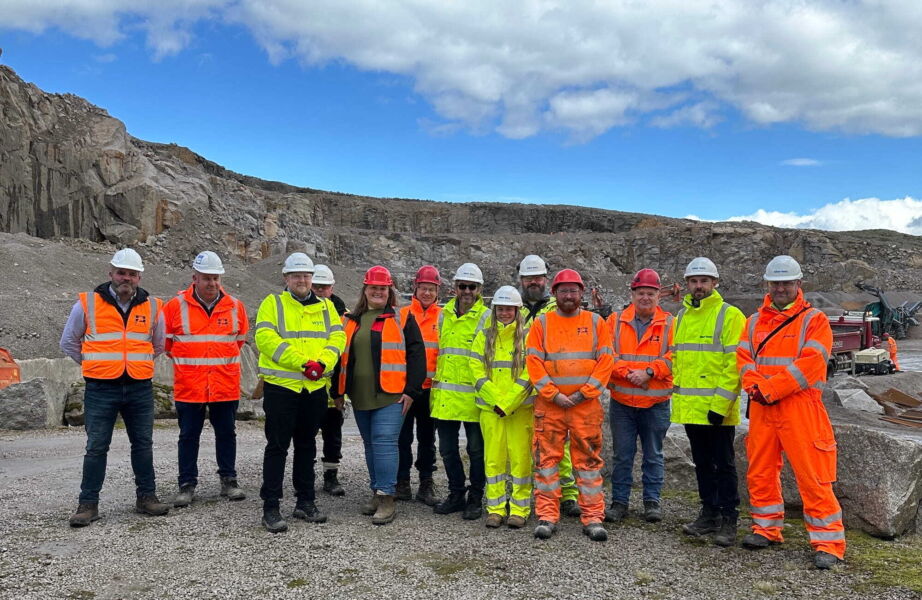
As part of the programme, teams from Wyre Council and Balfour Beatty were invited to Shap Quarry to witness the blast process and see first-hand how the rock armour is produced and quality controlled prior to delivery.
This close collaboration between quarry, contractor and client helps ensure that the specified rock armour grading, size requirements and material properties are achieved before the stone reaches site.
Rock armour may appear simple in concept, but its long-term performance depends on careful engineering and reliable supply.
For both rock armour coastal defence and rock armour flood defence projects, durability is fundamental. Armour stone must withstand decades of wave impact, tidal fluctuation, abrasion and freeze–thaw exposure without significant breakdown. Failure in material quality, grading consistency or placement can compromise the integrity of the entire structure.
A robust rock armour specification should clearly define:
Equally important is the ability of the supplier to consistently deliver stone that meets those requirements, particularly on large-scale schemes requiring hundreds of thousands of tonnes.
Proven experience on major infrastructure projects, dependable production capacity, and close collaboration with contractors and clients all contribute to successful rock armour construction.
With increasing pressure on coastal and river defences across the UK, correctly specified and responsibly sourced rock armour for sea defence and flood protection remains one of the most effective and resilient solutions available.
Rock armour is used in coastal and river environments to prevent erosion and manage hydraulic energy. It is commonly installed as part of rock armour coastal defence schemes, revetments, breakwaters and riverbank stabilisation works.
In both rock armour for sea defence and rock armour for flood protection, its purpose is to absorb and dissipate wave or flow energy to protect land and infrastructure behind it.
The required rock armour size specification depends on site conditions, including wave height, tidal range, slope angle and exposure.
Rock armour is typically specified by weight (for example 1–3 tonne, 3–6 tonne or larger classes). Coastal sites exposed to open sea conditions generally require larger stone than sheltered or inland flood defence projects.
Final sizing should always be determined through hydraulic design calculations to ensure stability under extreme storm events.
Rock armour grading refers to the permitted weight range within a specified stone class.
A defined grading ensures an appropriate distribution of stone sizes, promoting interlock and reducing voids within the armour layer. Consistent grading is essential for structural stability and long-term performance in both rock armour flood defence and coastal applications.
Key rock armour material properties include:
For exposed marine environments, durability is critical. Stone used in coastal engineering rock armour must withstand repeated wave impact and saltwater exposure over decades.
When correctly specified and installed, rock armour can provide protection for 50 to 100 years or more.
Longevity depends on factors such as stone quality, correct rock armour placement, hydraulic loading conditions and ongoing maintenance. Projects such as major UK sea defence schemes are often designed with a 100‑year service life in mind.
The terms are often used interchangeably, but “rock armour” typically refers to engineered, specification‑controlled armour stone used on major infrastructure and coastal defence schemes.
Rip rap can sometimes describe smaller, less tightly graded stone used for lighter erosion control works. Large‑scale rock armour construction projects generally require strict compliance with defined size and grading standards.
Made by Statuo

