Clitheroe

Shap

Horwich, Bolton

Chorley

Horwich, Bolton
Clitheroe
Shap
Horwich, Bolton
Chorley
Horwich, Bolton
A sandstone quarry in the Lancashire countryside might seem a long way from one of Barcelona’s most famous landmarks. Yet for over a decade, stone extracted from Brinscall Quarry near Chorley has travelled to Spain to support the continuing construction of the Sagrada Família.
The connection began when the project team searched the world for sandstone that could meet the visual and structural requirements of Antoni Gaudí’s extraordinary design. Brinscall’s distinctive beige sandstone was selected, beginning a relationship that continues today.
In 2026, that connection took on even greater significance when the Sagrada Família reached its full height for the first time. It’s a milestone we’re incredibly proud to have played a part in, and one that places a small piece of Lancashire within Barcelona’s skyline.
Construction of the Sagrada Família began in 1882. Antoni Gaudí took over the project the following year and transformed the original plans into the remarkable basilica recognised around the world today.
From 1914, Gaudí worked exclusively on the building until his death in 1926. Only part of his design had been completed by then, leaving later generations of architects, engineers and craftspeople to continue his work.
Progress has continued through changing construction methods, new technology and several major interruptions. More than 140 years after its first stone was laid, work on the basilica is still ongoing. The official history of the Sagrada Família shows just how many generations have contributed to the building.
Stone has always been central to Gaudí’s design. Sandstone from Montjuïc in Barcelona was used for the bell towers of the Nativity and Passion façades, but the original quarries were exhausted and suitable supplies became increasingly difficult to find.
The project therefore needed another sandstone that could sit comfortably alongside the original material and withstand the conditions it would face.
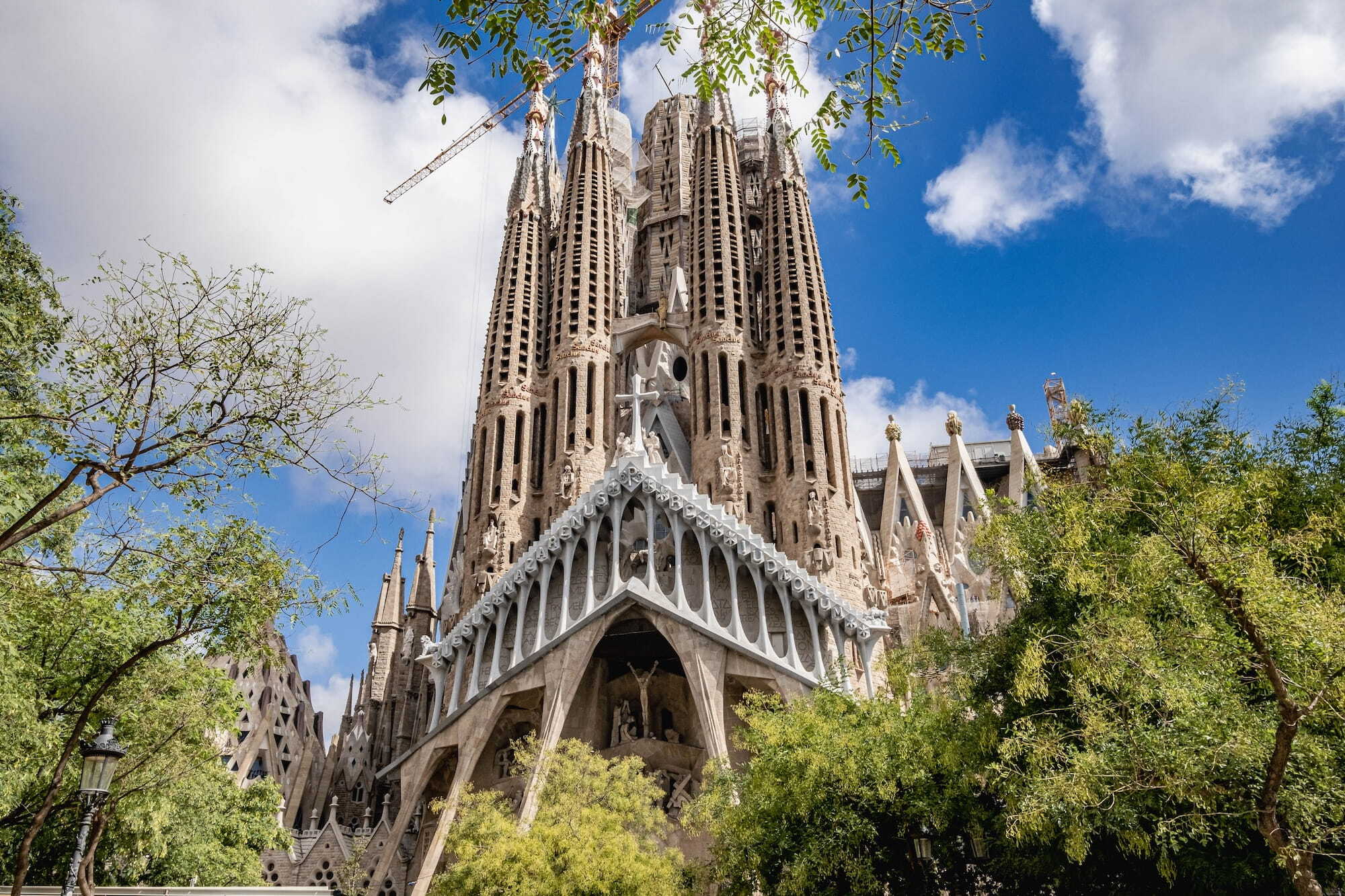
The Sagrada Família team carried out an international search for a suitable stone. Its colour mattered, but appearance was only part of the decision. The material also needed the right structural qualities and sufficient durability for Barcelona’s climate and urban environment.
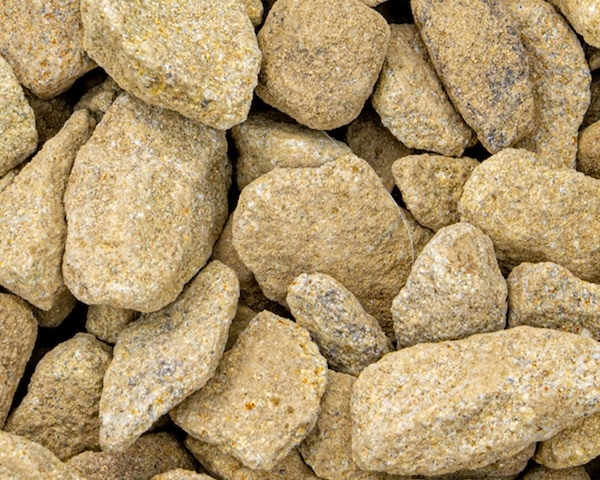
Sandstone from Brinscall Quarry was identified as a close match.
Emma Armstrong remembers how unexpected the initial enquiry felt. When the call first came through, the team wondered whether it could possibly be genuine. Once the scale of the search and the project’s requirements became clear, so did the significance of the opportunity.
Since then, Armstrongs has supplied numerous loads of carefully selected stone for further preparation and use in Barcelona.
Brinscall Quarry itself has been worked for more than 100 years. The 40-acre site produces sandstone for aggregates and dimensional stone, but material intended for the Sagrada Família requires a particularly careful approach.
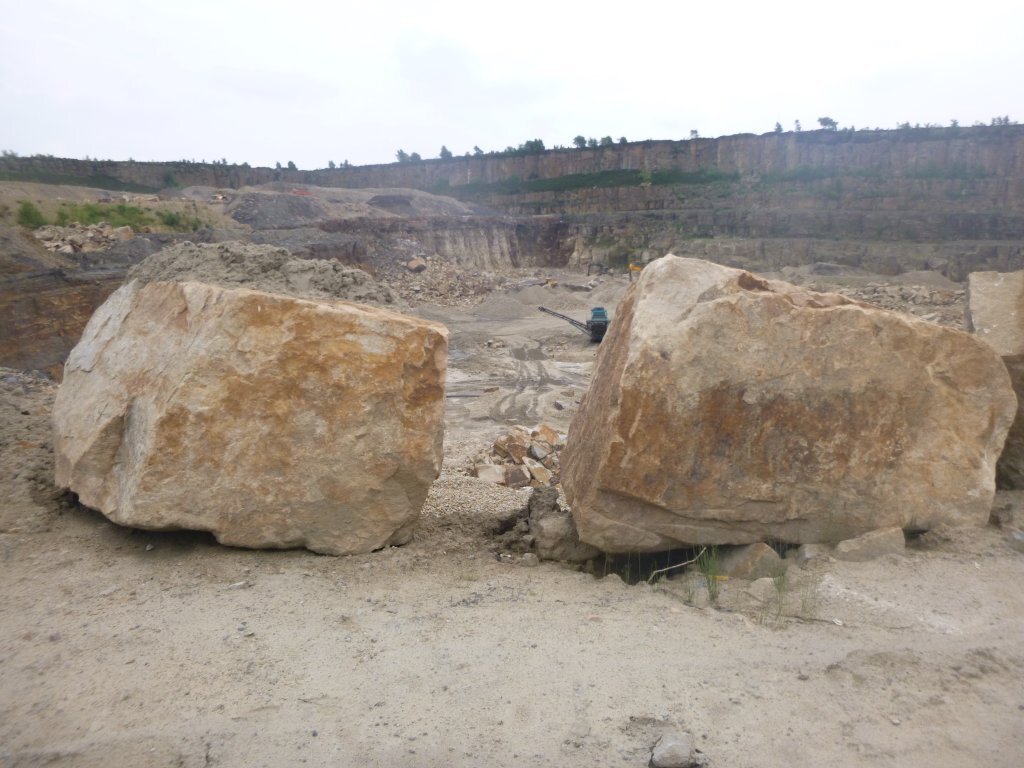
Stone quarried for aggregates can be blasted before being crushed and screened into different sizes. Large pieces of dimensional stone need to remain intact, so the extraction method is different.
At Brinscall, an excavator fitted with a ripper attachment works along natural breaks in the rock face to carefully loosen suitable sections of sandstone. This avoids the blasting that could introduce fractures or damage stone intended for architectural use.
Once a section has been released, a loader moves it away from the quarry face and onto stable ground, ready for transport to our stone workshop in Horwich.
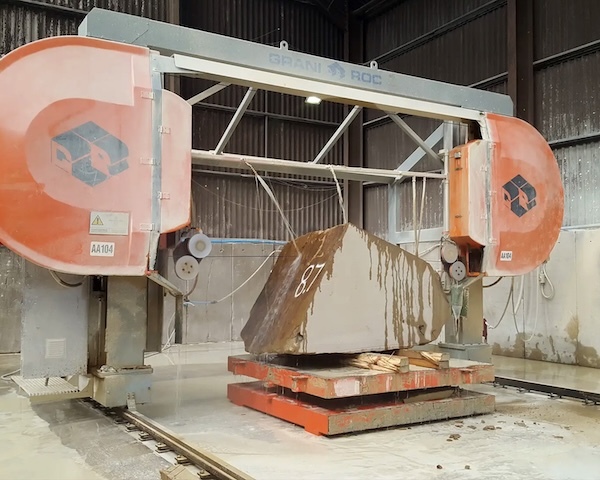
There, one of our stonemasons loads the stone onto a saw and removes a section. The newly exposed cross-section allows its internal quality and colouring to be examined before the material is approved for the next stage.
The stone can then be transported to Spain, where it is cut and shaped further for its intended position within the basilica.
You can also watch our video about Brinscall stone and the Sagrada Família.
On 5 September 2018, we welcomed Charlie Holt and the BBC Radio Lancashire digital team to see the process for themselves.
The visit began at our Horwich stone workshop, where the team saw how sandstone from Brinscall was cut and prepared before being sent to Barcelona. Later that day, Charlie joined our director, Emma Armstrong, at the quarry.
Being at Brinscall made the contrast between different extraction methods much clearer. Some areas showed the marks left by previous blasting, while the sandstone being selected for architectural work was loosened much more carefully.
During around an hour at the quarry, the visitors watched the excavator and loader move close to 200 tonnes of material. It offered a real sense of the scale of the operation and the care needed to identify and handle the right stone.
The journey from Brinscall to Barcelona was also featured in Channel 4’s Building Giants, which explored the complex engineering behind the Sagrada Família and some of the challenges faced by the people continuing Gaudí’s design.
On 20 February 2026, the upper arm of the cross was installed on the central Tower of Jesus Christ. The tower now stands at 172.5 metres, making the Sagrada Família the tallest church in the world.
The installation completed the exterior of the Tower of Jesus Christ and the group of six central towers. It also coincided with the centenary year of Gaudí’s death, giving the milestone added significance.
The Sagrada Família’s announcement marked the moment the basilica reached the highest point of its design after 144 years of construction.
For everyone at Armstrongs, knowing that stone from Brinscall has contributed to such an important building is a huge source of pride.
“It’s not every day that materials from a Lancashire quarry become part of a global landmark. There’s a real sense of pride knowing that stone from Brinscall is helping to continue Gaudí’s vision and that a piece of Chorley will remain part of this structure for generations to come.”
Reaching 172.5 metres was a major achievement, but the Sagrada Família isn’t finished yet.
Work inside the Tower of Jesus Christ is expected to continue during 2027 and 2028, while construction and finishing work elsewhere in the basilica will carry on beyond that. Reaching full height therefore marks the completion of one important phase rather than the end of the entire project.
Our connection with the building continues too. Further Brinscall sandstone has been extracted and prepared for assessment, with material carefully checked before it begins its journey to Barcelona.
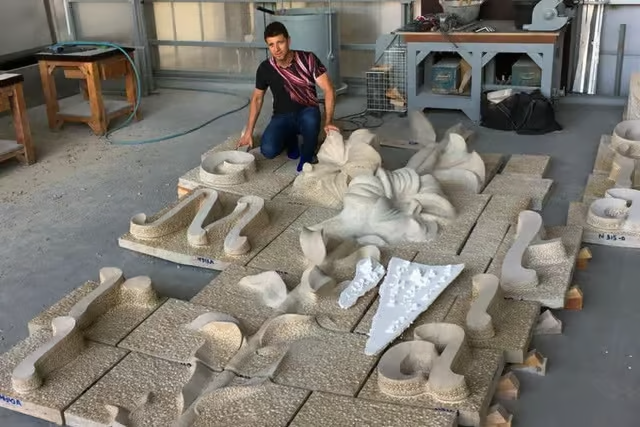
We recently welcomed Sir Lindsay Hoyle, Speaker of the House of Commons and MP for Chorley, to Brinscall Quarry.
The visit gave us the opportunity to show how the Sagrada Família stone is identified and extracted, as well as discuss the international interest created by Brinscall’s connection with Gaudí’s work.
Gaudí and the Sagrada Família have a particularly strong following in Japan. A travelling exhibition dedicated to the architect and basilica attracted more than 500,000 visitors across Tokyo, Moriyama and Nagoya between 2023 and 2024, according to the Sagrada Família.
We’re now exploring whether the same Brinscall sandstone could find new uses in Japan. Sir Lindsay’s visit provided a valuable opportunity to discuss how a local North West business might begin building connections within that market.
These conversations are still at an early stage, but they show how the story of one Lancashire stone could continue well beyond Barcelona.
The Sagrada Família has been shaped by generations of architects, engineers, stonemasons and suppliers from around the world. Armstrongs is one relatively small part of that much bigger story, but it’s a part we’re immensely proud of.
From careful extraction at Brinscall to preparation in Horwich and final shaping in Barcelona, every piece of stone has travelled a remarkable distance to become part of Gaudí’s continuing vision.
Explore more about Brinscall Quarry or contact the Armstrongs team to discuss sandstone and dimensional stone for your project.
Made by Statuo