Clitheroe

Shap

Horwich, Bolton

Chorley

Horwich, Bolton
Clitheroe
Shap
Horwich, Bolton
Chorley
Horwich, Bolton
When choosing the right aggregate for your project, you’ll likely be focusing most on the grading and size. However, particle shape is another important factor to consider, as it can have a significant influence on how a material performs.
Whether constructing roads, foundations or concrete structures, aggregate shape affects how particles fit together, compact under load and resist movement over time.
Knowing these differences can help you choose the most appropriate material for each application.
Aggregate shape influences how a material behaves during construction and throughout its service life. While grading controls the distribution of particle sizes, the shape of those particles influences how they fit together.
This affects everything from the amount of compaction required to the stability and strength of the finished layer.
The shape of an aggregate can influence:
These factors all contribute to the overall performance of the material, whether it is being used in a road sub-base, foundation, drainage layer, or concrete mix.
This means two aggregates with similar grading can perform very differently if their particle shapes aren’t the same.
Aggregate shape is not a single characteristic. A particle can be angular but flaky, or rounded but elongated. It is therefore useful to consider three related features: angularity, overall form and surface texture.
Angular particles have sharper edges, while rounded particles have smoother profiles. Form describes whether a particle is broadly cubical, thin and flaky, or noticeably elongated. Surface texture can range from rough to smooth. Together, these characteristics influence how particles move, pack and interact.
Crushed rock generally has sharp edges and a rougher surface. These features create friction between neighbouring particles and help them lock together when placed and compacted.
In unbound construction layers, this interlock helps resist sideways movement and creates a stable structure under load.
Angular aggregates are therefore commonly used for road sub-bases, railway ballast, asphalt and structural fill.
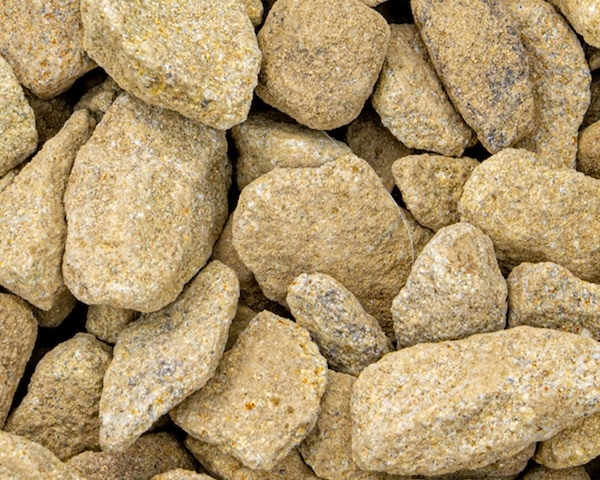
Rounded particles are often found in naturally occurring sand and gravel deposits, where weathering and water movement have gradually smoothed their edges.
Their smoother surfaces can improve workability, which can be useful in some concrete mixes. Rounded aggregates may also suit drainage and landscaping applications where their grading, cleanliness and other properties meet the specification.
Rounded aggregates can also be suitable for drainage and landscaping, provided their grading, cleanliness and other properties meet the requirements of the application.
Particle form is separate from angularity. Cubical particles have relatively even dimensions and will often pack and interlock more reliably without the thinner sections found in flaky material.
Flaky particles are unusually thin in relation to their size, while elongated particles are considerably longer than they are wide. If present in excessive amounts, they can align unevenly, make consistent compaction more difficult and be more vulnerable to breakage.
The acceptable proportion of flaky or elongated particles depends on the aggregate, its intended use and the relevant project specification.
Aggregate shape can be assessed using standardised testing methods. The Flakiness Index identifies the proportion of flat particles within a sample, while the Shape Index assesses particles according to the relationship between their dimensions.
The applicable limits depend on the aggregate, its intended use and the relevant specification.
The aim of aggregate compaction is to create a stable structure where particles are closely packed and able to resist movement under load. This is where aggregate shape and compaction are closely linked.
Angular particles naturally lock together as they are compacted. Their rough surfaces and sharp edges create friction between neighbouring particles, making the material more resistant to movement.
Angular aggregates can require more compactive effort to achieve the specified density, although grading, moisture content and the equipment used will also influence the result.
Rounded particles behave differently. Their smoother surfaces allow them to rearrange more easily during compaction, helping the material reach density with less effort. However, because they have less natural interlock, they may be more susceptible to movement when exposed to repeated traffic or heavy loading.
Selecting the appropriate aggregate shape therefore involves balancing ease of compaction with the long-term stability required for the finished construction.
Interlock occurs when individual particles fit together in a way that restricts movement. Rather than sliding past one another under pressure, the particles resist displacement and work together to distribute applied loads throughout the material.
Effective aggregate interlock can provide several important benefits, including:
These characteristics are particularly important in heavily loaded construction applications such as road foundations, working platforms, pavements, and structural fill, where the material must continue to perform under repeated loading over many years.
Aggregate shape has a significant influence on compaction, stability, and long-term performance, but it should never be considered in isolation.
The behaviour of an aggregate is determined by a combination of properties that work together to meet the requirements of a particular construction application.
Alongside particle shape, engineers and contractors will also consider:
For example, an angular aggregate with excellent interlock may still perform poorly if it is incorrectly graded or inadequately compacted.
Likewise, a well-graded material with rounded particles may be entirely suitable for applications where drainage or workability is the priority.
Selecting the right aggregate is therefore about understanding how these properties interact, rather than focusing on any single characteristic. Ultimately, good construction depends on choosing materials that satisfy the project specification as a whole while delivering the required strength, durability, and performance.
Selecting an aggregate isn't simply about choosing the closest available material. Considering particle shape alongside other key properties can help ensure the finished construction performs as intended.
Use the checklist below to assess whether the aggregate you're specifying is appropriate for the application.
✓ Does the aggregate provide sufficient particle interlock?
✓ Is the particle shape suitable for the intended application?
✓ Will the material achieve the required level of compaction?
✓ Does it meet the relevant project specifications?
✓ Is long-term stability more important than ease of placement?
✓ Have grading and particle shape been considered together?
If any of these questions cannot be answered confidently, review the material specification and proposed compaction method before work begins.
For guidance on choosing the right aggregate for your project, speak to our expert team at Armstrongs today.
Made by Statuo